This is just a short one - my brief rant about the early abandonment of a promising network card.
I bought a KillerNIC M1 at the end of 2008 in order to reduce ping time in online games. I have tended to stay well back from the top of the line where the general purpose CPU is concerned in systems I build for myself, so I had high expectations about the benefit I would see from this card offloading additional work.
I was pleased with the overall performance of this card on my 64-bit Vista system once I upgraded to the latest beta drivers at the time (4.1.0.36).
But here is the problem - those beta drivers were the last drivers they ever ‘released’ for this card - and you can only get those by digging around on the beta forum. Windows 7 is on the horizon and there is no word on any support for these cards other than reports of BSODs from early adopters.
I am having flashbacks to my driver experience with ATI video cards back in the day (around 2000) when it took them forever to get new drivers out for newer platforms.
So here is my message to you Bigfoot - I NEVER buy ATI cards. I don’t care what their benchmarks or feature checklists show. NVIDIA always gets my business because of the terrible support I received from ATI almost a decade ago and because of the awesome driver support NVIDIA has always provided.
Someday maybe - if NVIDIA drops the ball - I may take another look at an ATI card.
Right now Bigfoot is in the doghouse - you guys can forget about any more business from me and I will recommend against your products every chance I get.
This will be an evolving post providing summary info about software development topics of interest to me. I will include links to papers written by me, but most of the others are IEEE or ACM journal articles that cannot be freely distributed. I will strive to provide links to the abstracts where possible.
The process of building software systems involves many different activities, but it seems to me that the rubber meets the road with the architecture. This coarse, componetized view of the system is where the requirements first run into an objective measure. Yet it is the architecture itself that must be evaluated with respect to the requirements. The artifacts produced by the architect often anchor communication between the stakeholders on a project, and they will serve as the entry point for team members to begin understanding the system.
I will add some more detail on each of these aspects soon: Systems Engineering Process Activities (SEPA), ATAM, Evaluating, Software Development Process/Lifecycle, Tool for Communication
My graduate work focused on a couple of key architectural components - the construction of a Domain Object Model (this is akin to the Domain Reference Architecture in the SEPA process) from a set of requirements elicitation interviews, and the evaluation of that model against standards of completeness and correctness.
Thesis: Establishing the Completeness and Correctness of a Domain Object Model
Another very interesting subject area for me was Data Mining. Here I used tools like Weka (now absorbed into the open-source Pentaho suite) to extract novel, actionable knowledge from data warehouses. I had an opportunity there to collaborate on an interesting case-study using convenience store data.
KDD (Knowledge Discovery in Databases)/Data Mining: Knowledge Mining Convenience Store Sales Data
Software testing generates a great deal of zealous discussion among developers. 100% code coverage, black box, white box, mutation detection, unit, functional, acceptance, test driven development (TDD), integration, system - all of these aspects of testing software must be stacked up against the businesss value delivered. What we need is a good return on investment for the time and effort spent writing, executing, and maintaining the tests. My ideas on the subject have evolved quite a bit over the years. One interesting project I worked on involved implementing the Korat unit testing algorithm with a GUI to allow incremental improvement of the key evaluation routine. Interestingly enough, I later came across a commercial product (Agitar) that did a very nice job with a similar solution. There is no Korat in the mix (as far as I know), but it does a nice job of allowing the developer to manage the state-space explosion problem nonetheless.
Verification and Validation of Software Systems: Korat Visual Finitization Editor
More to come…
Since Mytoons.com has been offline for some time now, I think it would be nice to archive some of the key features of the site and its related applications here.
Way back in the summer of 2006 the founders of Bauhaus Software decided it was time to move beyond the animation tools market and deliver a new capability for animators to showcase their work, share it with the world, and potentially earn something for their efforts. I was hired that August as VP of Web Engineering to build this vision into a working product/platform.
From the outset the founders identified a threefold strategy for growing the business that could be summed up as create-share-sell. We would provide tools with which animation students could create, provide a web portfolio site for them to share their work, and provide an ecommerce platform they could use to monetize that work.
This ambitious vision was initially tackled with a programming team of two and a talented graphic designer. The other programmer was a gifted recent college grad named Jason Sims, who has since gone on to do a variety of freelance work. The designer (who also dove into some of the front-end coding work) was Franklin Lyons, who has also gone freelance and produced some nice work.
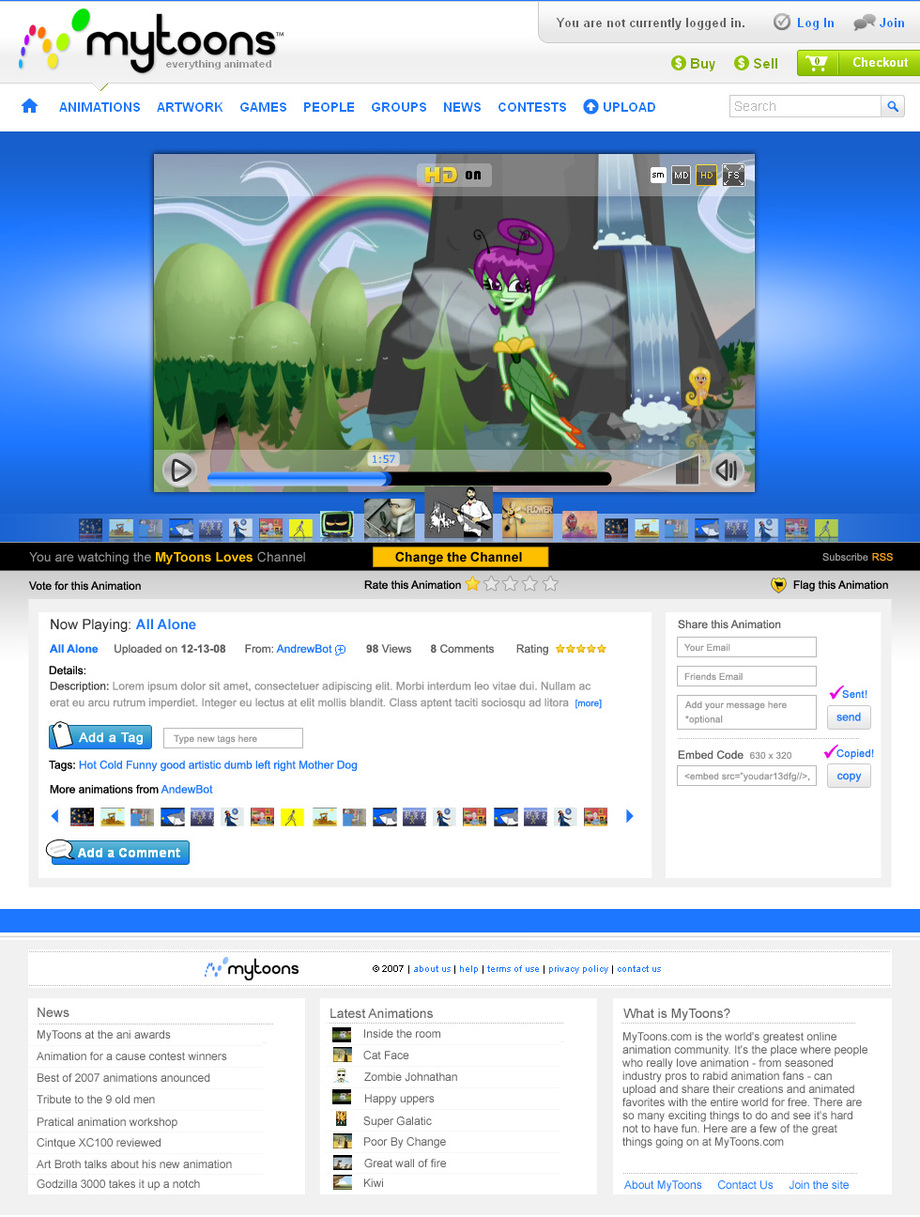
The following screenshot is of one of the last revisions of the Mytoons home page. I have been searching for an early mockup to contrast with it, but I have yet to lay my hands on one. Note the HD resolution option. We were ahead of the curve where video quality was concerned.
From the outset there were many facets to the development of the site. I spent quite a bit of time in the early days deciding on the solutions for video transcoding, DRM/Copy Protection, development processes, the physical and logical deployment topologies, licensing and copyright issues, and a thousand other things. I think a future writeup of the post-mortem analysis would be interesting, but for this first article on the Mytoons history I want to focus on the major features of the site.
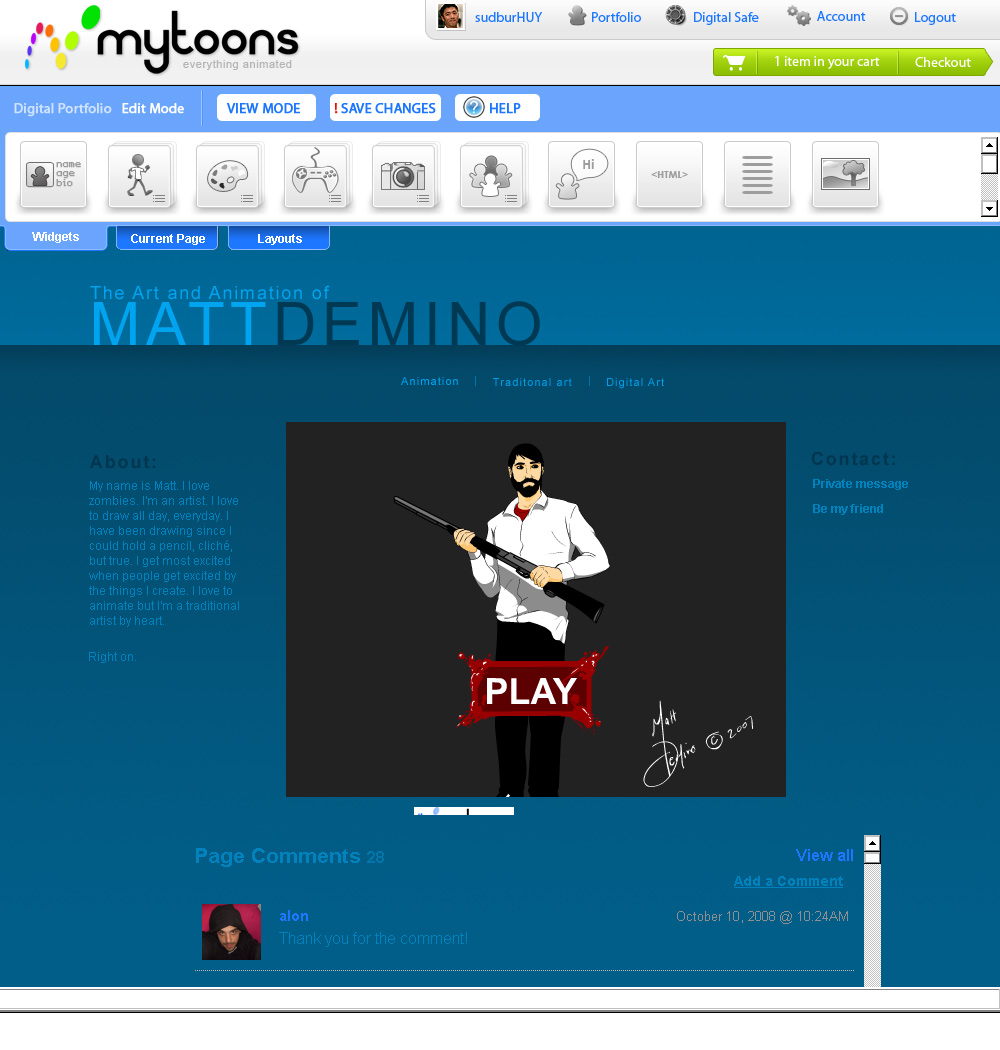
The Digital Portfolio System evolved into a very nice widget-based CMS for animators to showcase their work with all of the flair and attention to detail that an artist requires. The following shot is a page in edit mode allowing the animator to select and edit widgets for the page.
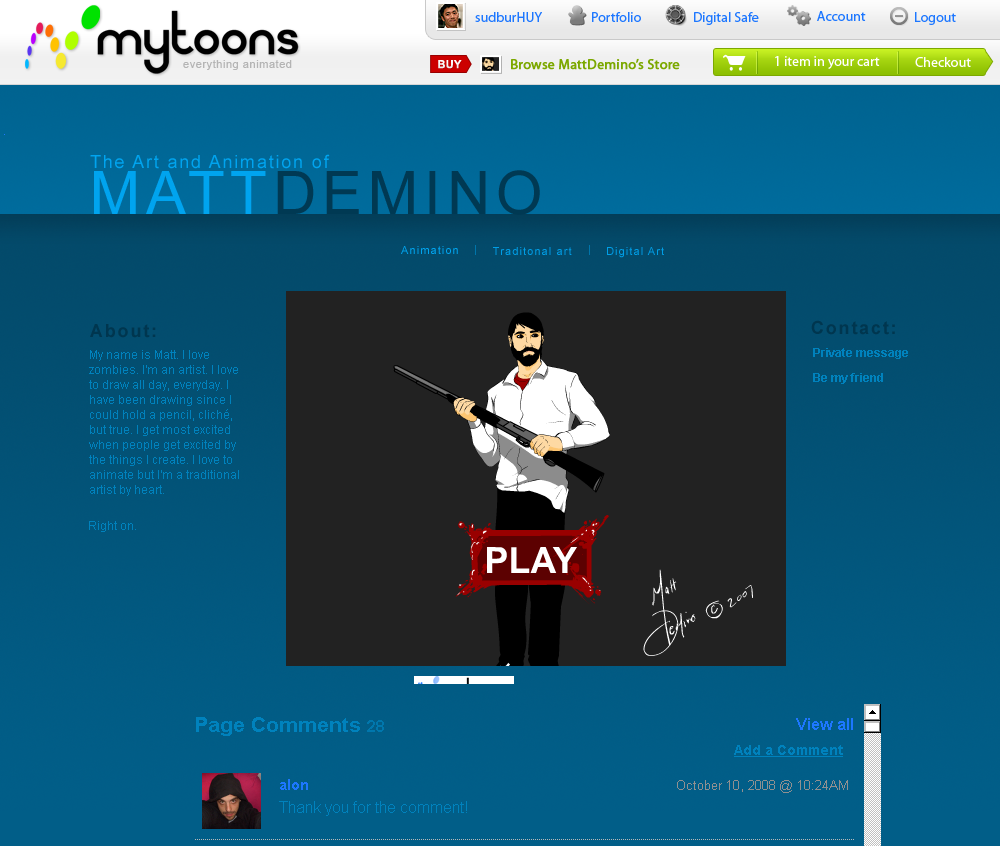
The same page in view mode as the world would see it. Animators had a direct link into their personal store catalog if they had animations for sale.
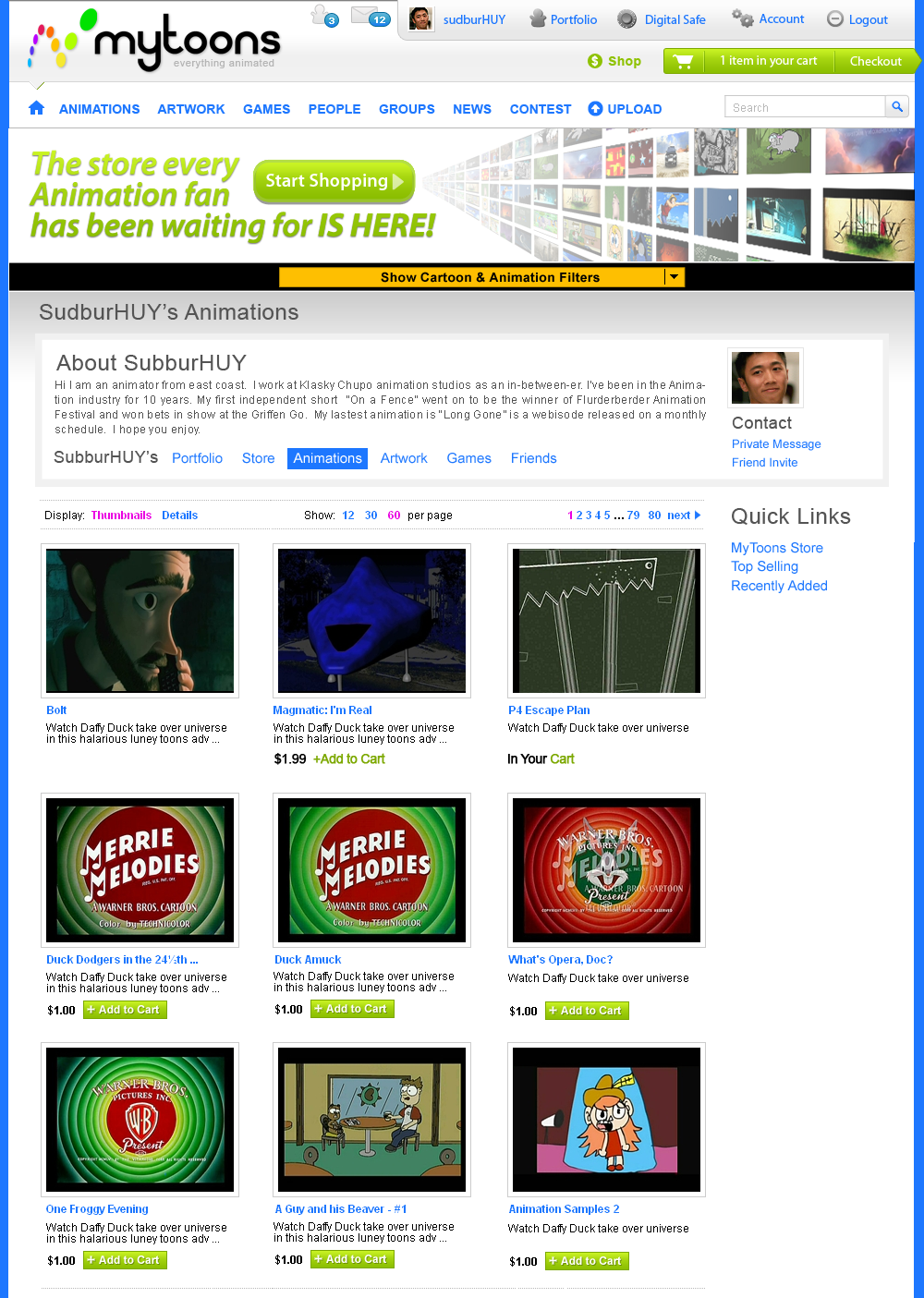
This is a list page that illustrates how store content and free content were mixed on the site. An animation fan could browse and watch for free or purchase the premium content for offline viewing.
Another example of the premium and free blend - this is a play page where a user would have just finished watching a free animation that had associated premium content. The Flash player and the page content both direct the fan to the store for additional content.
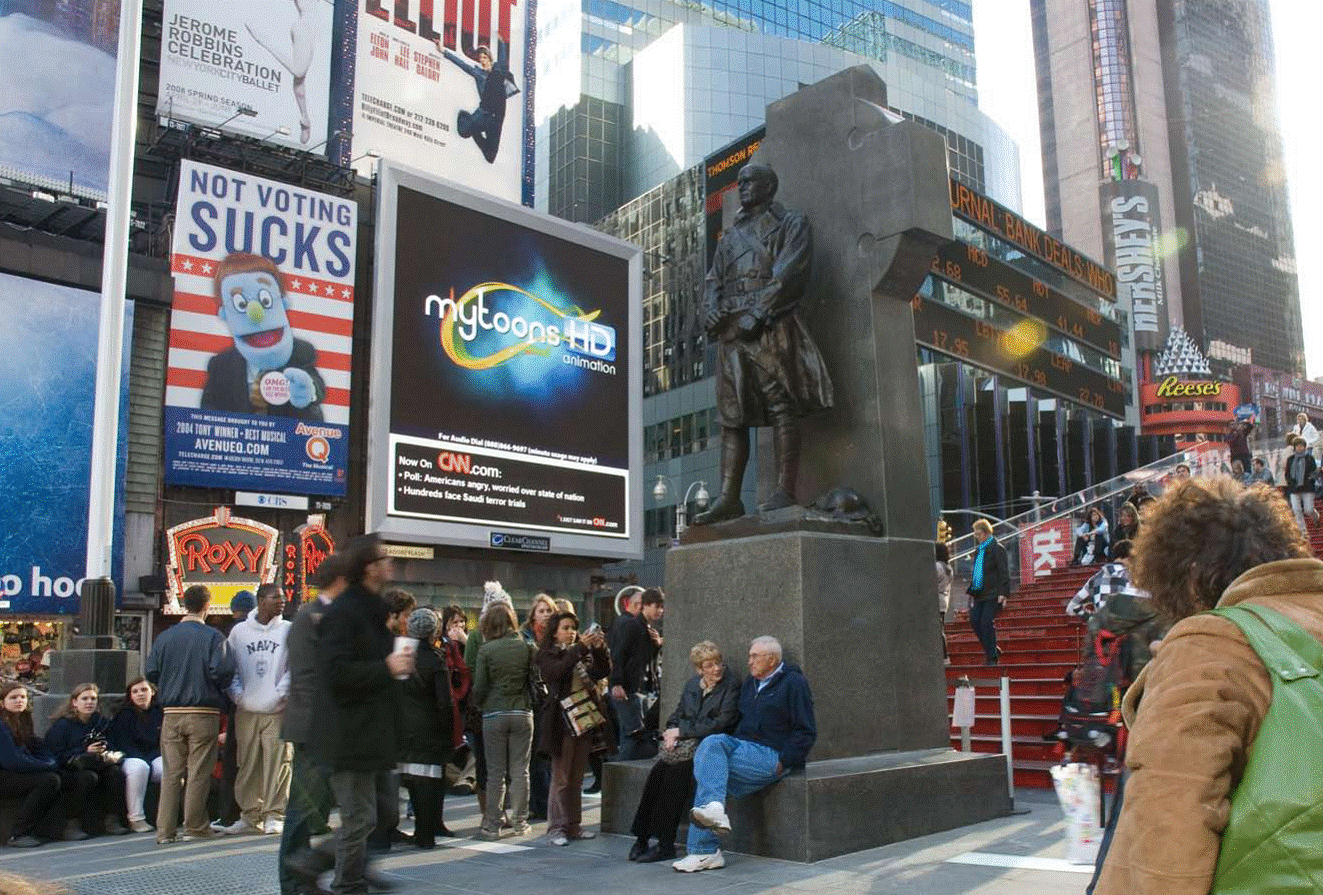
We held a contest to kick off our launch of HD Animation in June of 2008. The winner got a trip to New York and got to see their animation play in Times Square. This picture represents the achievement of the Mytoons vision - a talented animator got to showcase their work and gain some exposure.
Allan Dye’s account of his winning trip is available here:
http://allandye.blogspot.com/2008/11/mytoons-get-with-times-trip-to-ny.html
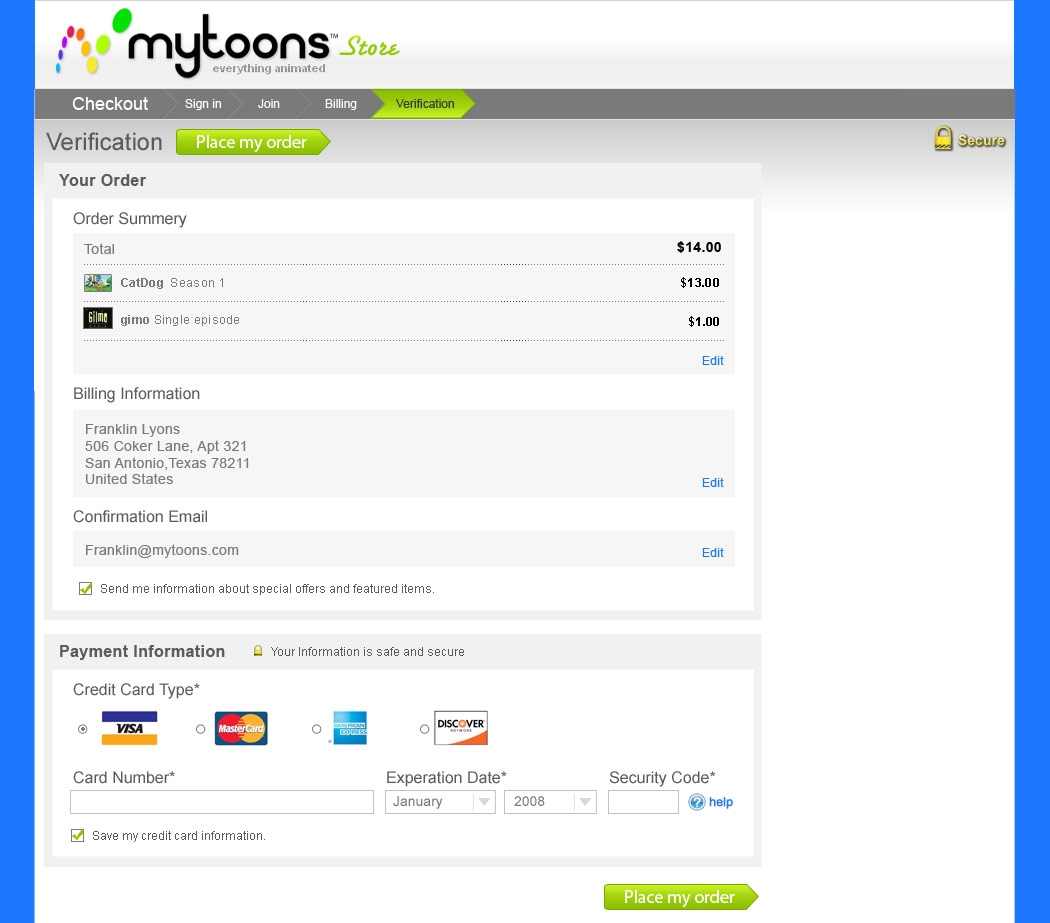
This is the ecommerce pipeline in action. Revenue at last!
More revenue…
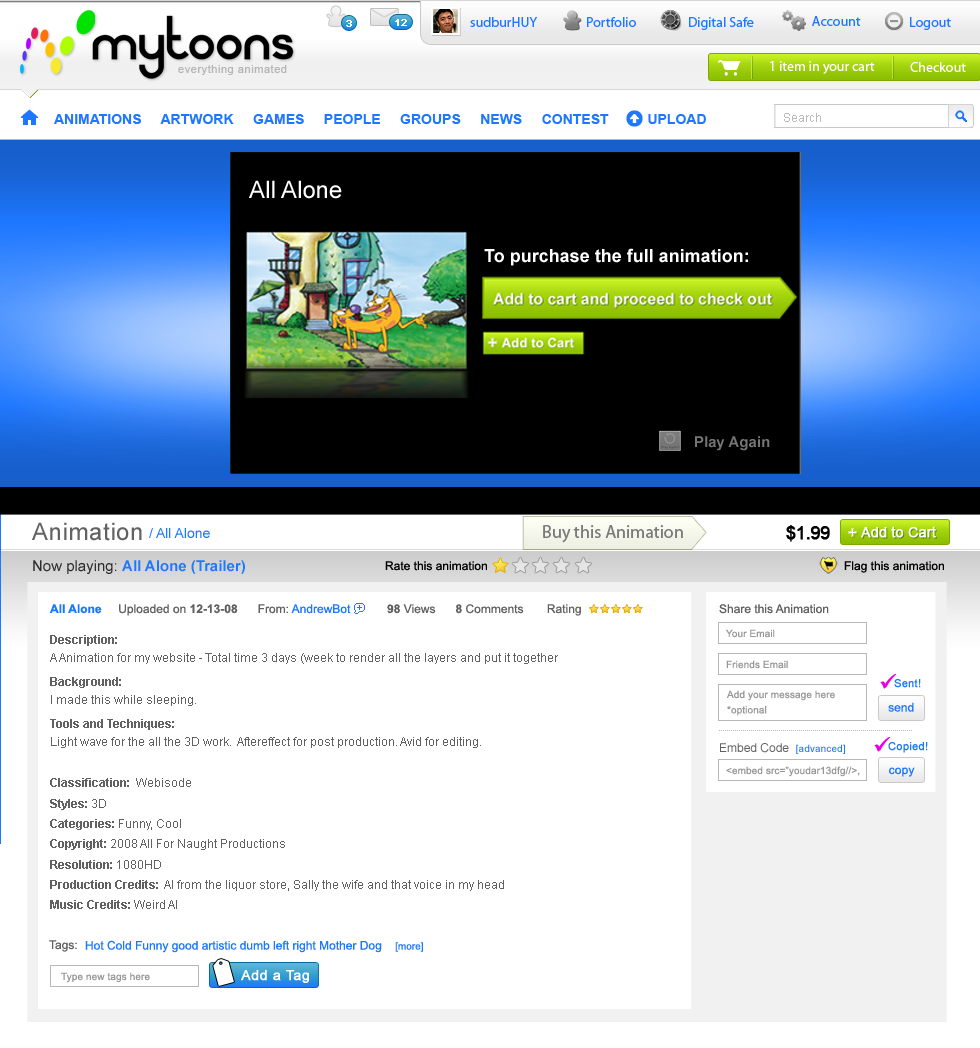
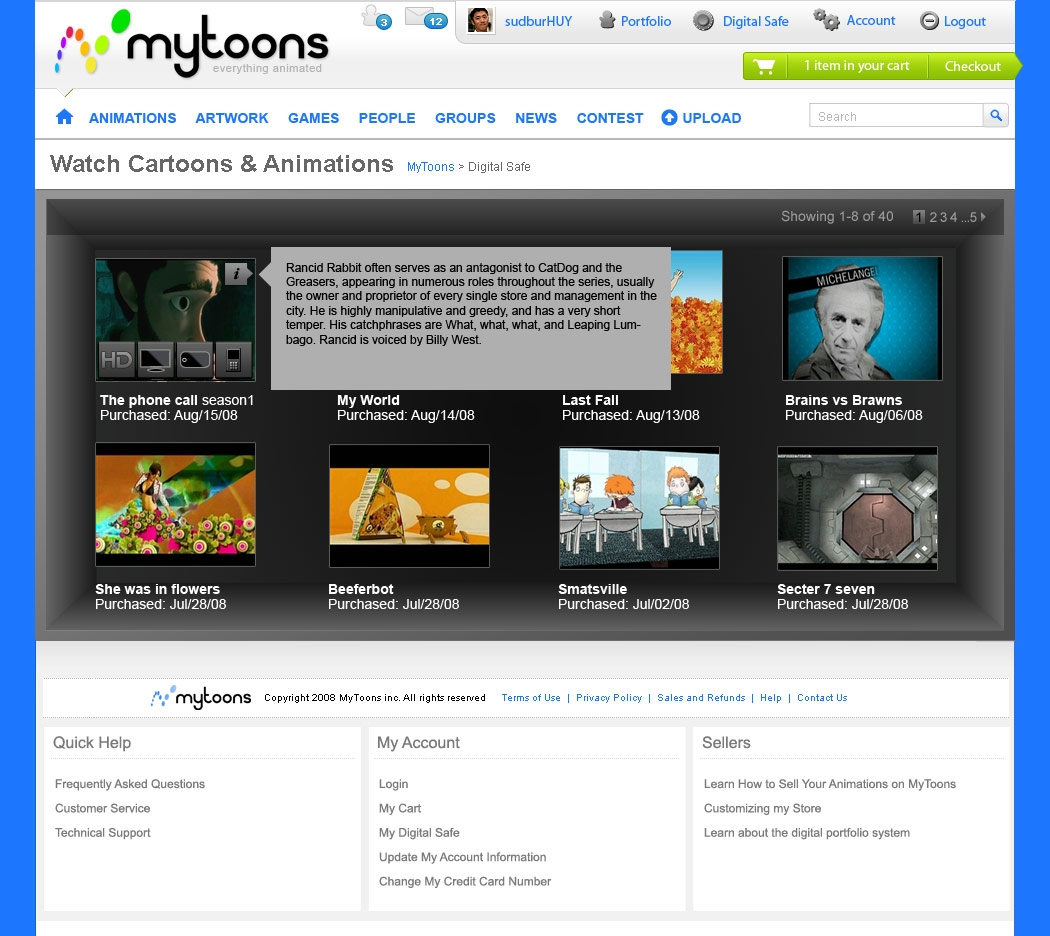
The Digital Safe is where you went to grab all of your purchases. Animations sold through the mytoons store were available in a variety of formats from 3gp to iPhone to 1080P HD. Once you purchased a title, you could at your leisure download it whenever you liked.
There are many good stories in the history of Mytoons - including several of the sprints we executed to deliver the HD and store milestones, the NDB Cluster fiasco, searching with ferret/solr/google, melting databases, sneaky ads wreaking havoc, caching, outages, and more. I will try to hit the high points in another post.
Back in the good old days when I seemed to have more spare time for that sort of thing I played with selling some mp3 and CD recordings of multi-track hymns I recorded.
Well, crocketthopper.com has been defunct for a couple of years now, and I don’t see myself ever getting back to attempting to sell the music - so here it is:
Free for your listening pleasure
oh-jesus-my-savior
tallis-evening-hymn
return-oh-god
oh-tell-me-no-more-of-this-worlds-vain-store
supplication
samanthra
almighty-king-whose-wondrous-hand
I had a professor in my software engineering program at UT who said that “Code is the dessicated relic of a long intellectual process.” I have never heard it put better. I am a big believer in the “Say it in code” principle - that your code should be simple and readable enough for others to understand (or at least yourself when you look at it again a year later and wonder “Who wrote that mess?”). Experience tells me this is not sufficient. Object-Oriented Analysis, Design, & Programming (OOA,OOD,OOP,OOAD,OOADP, or OOADD for those with short attention spans) has proven itself to me as the best available technique for maintaining the original intent behind code - after all, the behaviors and the state live together in modules that encompass a domain concept - if we have done our jobs.
OOADP also gives us more tools in our toolboxes for tackling complexity problems - if you look at the classic Object Oriented Analysis you can see that while functional, procedural, and data-flow techniques are suitable for certain classes of problems, an OOADP approach encompasses those and adds flexibility - especially in complex interactions of part-whole, is_a, has_a, and acts_like_a domain relationships.
By the way - the most under-read book on OOP is Streamlined Object Modeling.
Streamlined gets us the rest of the way there on being able to look at a system years later and understand what is going on. The appropriately-named DIAPER process “catches all the crap” and the whole book presents a dozen patterns (most of you probably think of these as analysis patterns) based on about a hundred principles - along with sample code for Java and Smalltalk.
I think the beauty of Streamlined is that by taking some decisions away (constraining our design and coding to the dozen patterns), we are freed to focus on the problem domain. It helps by reducing the arbitrary complexity that Brooks bemoans in The Mythical Man Month - because when you go look at a Streamlined object you know where to find stuff and you can quickly grasp how it interacts with other objects to get the job done.
And all is well with the world. Well, not quite. You see, in the real world these days - even if you are cool like us and write Ruby on Rails Web Applications - most of your system state resides in a relational database. Sigh. The Object Relational Mapping problem has served as some great fodder for theses and dissertations - not to mention lots of consulting dollars. Because at the end of the day all of that extra power I was bragging about object-think having over data-flow or functional or procedural or whatever older programming technique your technology stack forced upon you - all of that gets diced to shreds when you start to bolt your system onto the relational database.
Inheritance is a problem for databases. Single-Table or Multi-Table - you want to be able to collect, select, inject on your sets of objects without doing an 8-way-join? Sorry. Cost of doing business. Cache your app like mad and keep going.
OK. That works fine for toy apps. And I good-naturedly include any app where the domain complexity does not overwhelm the technical issues - even if you are generating a billion hits-per-second or whatever you lucky dogs are doing these days no jealousy at all there friends!
What I am trying to get at here is that even with a powerful abstraction like Active Record (see Martin Fowler’s book Patterns of Enterprise Application Architecture for the general case and Ruby on Rails for an incredible implementation) - any time we have to think about the fact that there is a database under there it detracts from the ability of the development team to maintain momentum on new features and the evolution of the system as a whole.
The nature of a business application is to change - I cannot recall the name of the classic paper - but business apps were categorized a long time ago as a system which is not simply simulating the world - it simulates some things sure - but it also changes the world as soon as it is released. A good business application provides the business with capabilities it did not have before. And as soon as a business has new capabilities it will capitalize on them - you guessed it - there will be immense pressure to change the system to provide new capabilites built upon those just created.
That is a good summary I think of why software is a lucrative field and why thinking practicioners of the software art need never fear running out of cool work to do. Each time we innovate for our customers or our employers (they are our customers too after all) - every time a new system leaves the abnormal state of the lab and starts breathing in the real world, it better be solving some key business problem. Then those customers are going to look around and say “Wow! If we can do this, then what about …”.
So we need to stay fast and agile - ready to respond to those wonderful changing business requirements that let us know the system is still alive and still being used to do stuff. And a relational database makes that problem a little harder.
Am I just ranting? Mostly. But there is hope for us OO purists. Seaside can run on Gemstone - an object store that persists state across servers and on disk (the way most of us use the database) without having to wrestle with the ORM problem. And I have long had a desire to really learn the Smalltalk way of doing things - but so far I have not gotten around to it. So what really melts my butter these days is Maglev - a project to make the Gemstone architecture support Ruby (or a project to make Ruby run on the Gemstone architecture if you like).
It bugs me that the Rails community is not talking about it more of late - my impression is that since it is not open and free (yes, Gemstone is made by a real company and they stubbornly wish to keep the system proprietary) that the community wants to ignore it. I have been scouring the web for press on the RubyConf2008 talk about Maglev, and I have found only a couple of tweets! I am waiting with bated breath for Confreaks to release their videos so I can finally see what I missed.
I think we can at least talk about the technology. Gemstone does have a free license for many classes of application. And for those of us with big systems like mytoons.com - we’ll just have to negotiate
Finally a little encouragement to the Maglev team themselves - lets get some blogs going and an alpha or a beta out there to experiment with. I am ready to turn ActiveRecord into a no-op! Well, at least an abstraction where I don’t have to worry about inadvertantly introducing a database crippling query into the mix by asking my object model an interesting question. Cheers for turtles all the way down!
In Witness, Whittaker Chambers notes that feeling men of all stripes cannot help but be moved by the plight of their fellow man as they stuggle through the world - daily facing the curse of the world and struggling with disease, poverty, injustice, and death. He observes that the Communist is responding to this crisis by trying to ensure that all men are treated justly. The truly idealistic Communist seeks the good of all in his effort to promote a fully egalatarian society through the power of government.
The results of the last election affirm the insight of Chambers in stating that you cannot fight such a revolutionary spirit by simply standing for the status quo ante. The furor of the revolutionary can only be overcome by a counter-revolutionary spirit that is just as zealous in standing for an opposing principle.
Many pundits these days are rejoicing or mourning the death of conservatism based on a cursory analysis of the last election. There is ample bickering within the Republican party about the decisions made in the campaign and about the reasons for their defeat. I have heard of several who espouse a more moderate party going forward to try to win the middle and stand against the extreme liberal (socialistic and even communistic) forces represented by President-Elect Obama and his forthcoming administration.
It seems to me that the lesson of history, and the wisdom of Whittaker Chambers in particular, rails against such a course. It is not a moderate or lukewarm philosophy that can stand against the power of the revolutionaries who want to turn the United States into a mothering, protecting entity that will at least ostensibly attempt to provide justice and succor to all. It seems to me that what is required is an empassioned, articulate defense of the principles of liberty that conservatism represents.
What is required is a shout from the rooftops that socialism and communism are evil - that even though these concepts seem prima facie to be noble and good, they make great promises about the good of society and being fair to all - they fail to account for the fact that every human being has a soul. That to oppress the soul of a single human being for any well-meaning cause is to commit the greatest of atrocities. The abstract good of the collective can never be allowed to cause harm to the individual. The conservative also desires to save the world - but one life at a time, one family at a time - in the small, but also in the concrete. This is why The Forgotten Man must never be forgotten.
President-Elect Obama made a comment on the stump about selfishness. His claim is apparently that the desire of an individual to act as a free moral agent - making his own decisions about his life, liberty, and property - constitutes a selfish act. The desire to reduce the scope of government - and lets not forget that government exists by consent of the governed - and act freely with the ability and substance that we have - is not selfish - but simply the only sane course of action. In a masterful verbal pivot he compares his childhood act of sharing his own lunchtime sandwich with another child to the federal government taxing working Americans and redistributing those funds to others. This is more akin to a young Obama forcing one child to give a portion of his sandwich to another.
Greetings friends, family, cohorts, peers, etcetera, etcetera, etcetera!
I expect the focus of this blog will evolve over time - but for the moment I plan for this public diary to span personal, political, and professional topics ranging from Software Engineering to liberty to the value of human life - body, soul, and spirit.
I have read that most blogs are read by at most a dozen people - so I will approach this public/private endeavor with an expectation that most of my readers are already acquainted with me in some way. Clay Shirkey makes some great observations about the weirdness of this phenomenon in his book Here Comes Everybody - writing a blog is like having a conversation in the food court of a mall - it is sort of private, but eavesdroppers abound. In the blogosphere however, this behavior is encouraged